What Hollis Scarborough’s Research Tells Us About the Language Origins of Dyslexia
Last month I enjoyed attending the 2026 Research to Practice symposium at the AIM Institute for Learning and Research. AIM is a private school for children with reading and learning difficulties; in recent years they have branched into other areas such as teacher education. Every year they honor a researcher for their contributions to reading research and practice. The award is named for Hollis Scarborough, a distinguished researcher who many teachers know from her “reading rope” illustration. As part of AIM’s 20th anniversary celebration, several of the award winners returned to give talks: me, Don Compton, Linnea Ehri, Laurie Cutting, Ken Pugh, and Kate Cain, and Hollis herself. It was a fun event and the talks were great; they’ve been posted here.
My talk focused on the instructional needs of dyslexics and typically-developing children, continuation of the discussion here. There’s a commonly-held view that all beginning readers benefit from the same kind of instruction, varying the “dosage” as needed. This view overlooks the fact that children’s instructional needs differ not just in amount but in what needs to be taught. It’s true that reading capacities exist along a continuum, with no definitive border between dyslexic and nondyslexic. It’s also true that children need to learn the same things in order to read. However, it isn’t true that they all learn the same ways. Children with conditions that seriously interfere with reading benefit from a greater amount of explicit instruction about a wider range of components of reading than typically-developing children. See my talk, the slides, and my previous post for details.
The topic of this post, however, is Hollis’ research on the linguistic origins of reading difficulties. It appears that the role of language in reading development is gaining more attention among “science of reading” influencers and advocates (as seen here, for example). Recent science of reading legislation in states such as Minnesota and Indiana name-checked the Big 5 from the National Reading Panel report, but also included language. Same with the teacher PD materials developed by NYSUT (New York State United Teachers). If language is indeed the happening thing in the Science of Reading, great. There is a truly extensive research literature showing that progress in reading depends on knowledge of spoken language. Differences in spoken language, which exist for a variety of reasons, lead to differences in reading. As I said in my book “Children’s entry into reading and how fast they progress depend on their knowledge of speech. Because it is so crucial to becoming a reader, measures of prereaders’ spoken language are strong predictors of later progress” (p. 106).
Scarborough conducted the breakthrough study on this topic. I wish that this study, and the subsequent research it stimulated, were as well known in education as the reading rope. Here is a good summary of the study as generated by ChatGPT from my prompts, with minor corrections:
Hollis Scarborough’s (1990) Child Development study, “Very Early Language Deficits in Dyslexic Children,” used a prospective longitudinal design to identify early precursors of dyslexia. Children were followed from approximately age 2½ through second grade, with many drawn from families with a history of reading disability. This allowed Scarborough to distinguish between children who were merely at familial risk and those who ultimately developed dyslexia. Language abilities were assessed repeatedly before reading instruction began, and reading outcomes in second grade were used to classify children as dyslexic or typical readers.
The study measured multiple components of language across development. At age 2½, assessments focused on expressive language, including mean length of utterance, syntactic complexity, and pronunciation accuracy. At age 3, children were tested on receptive vocabulary and naming. By age 5 (pre-reading), measures included phonological awareness, letter–sound knowledge, and naming speed. Scarborough then analyzed how these early language skills predicted later reading ability, including whether early measures contributed uniquely beyond later ones.
The central finding is that children who later became dyslexic already showed measurable language deficits by age 2½, well before formal reading instruction. These early weaknesses were most evident in expressive and structural aspects of language, such as shorter utterances, less complex syntax, and poorer articulation. Notably, there was little evidence at this stage for deficits in basic speech perception or lexical comprehension, suggesting that the earliest differences are not primarily perceptual.
As development progressed, these early language weaknesses expanded into broader linguistic deficits. By age 3, affected children showed poorer vocabulary and naming performance. By age 5, they exhibited the more familiar profile associated with dyslexia risk: deficits in phonological awareness, letter–sound knowledge, and naming. This pattern supports a developmental cascade, in which early language weaknesses give rise to later phonological and literacy-related difficulties.
A key result is that early syntactic ability predicted later reading outcomes even after controlling for pre-reading skills at age 5. This indicates that early language is not simply an immature form of later phonological ability but contributes independent explanatory power to reading development. In other words, deficits in early language structure are not fully reducible to later phonological deficits.
Importantly, not all children from dyslexic families showed early language problems, and those who became typical readers generally had normal early language development. This finding weakens a simple genetic-risk interpretation and suggests that early language deficits are more specific predictors of dyslexia than family history alone. Additionally, children’s early language performance was not explained by maternal reading ability, arguing against a purely environmental account based on literacy exposure.
Overall, Scarborough’s study demonstrates that dyslexia is best understood as a developmental language disorder with origins in early childhood, rather than a problem that emerges only when children begin reading. The findings challenge accounts that treat phonological awareness deficits as the primary cause, instead showing that these arise later from earlier weaknesses in language production and structure. The study also highlights the potential for very early identification, as meaningful predictors of reading difficulty are observable several years before schooling begins.
In short: Young children’s language abilities differ. Because of the role of language in reading, these language differences yield corresponding differences in reading. Reading difficulties that manifest in 1st grade typically originate not with reading but with spoken language.
Scarborough’s pioneering study was later replicated and improved-upon by other researchers. Here’s a figure summarizing the results of a prospective, longitudinal study by Charles Hulme and colleagues (here) who followed children from age 3 to age 8. They documented a developmental cascade of effects: oral language differences at age 3 leading to subsequent differences in reading development, including reading comprehension at age 8. These studies are discussed on pp.168-170 of my book.
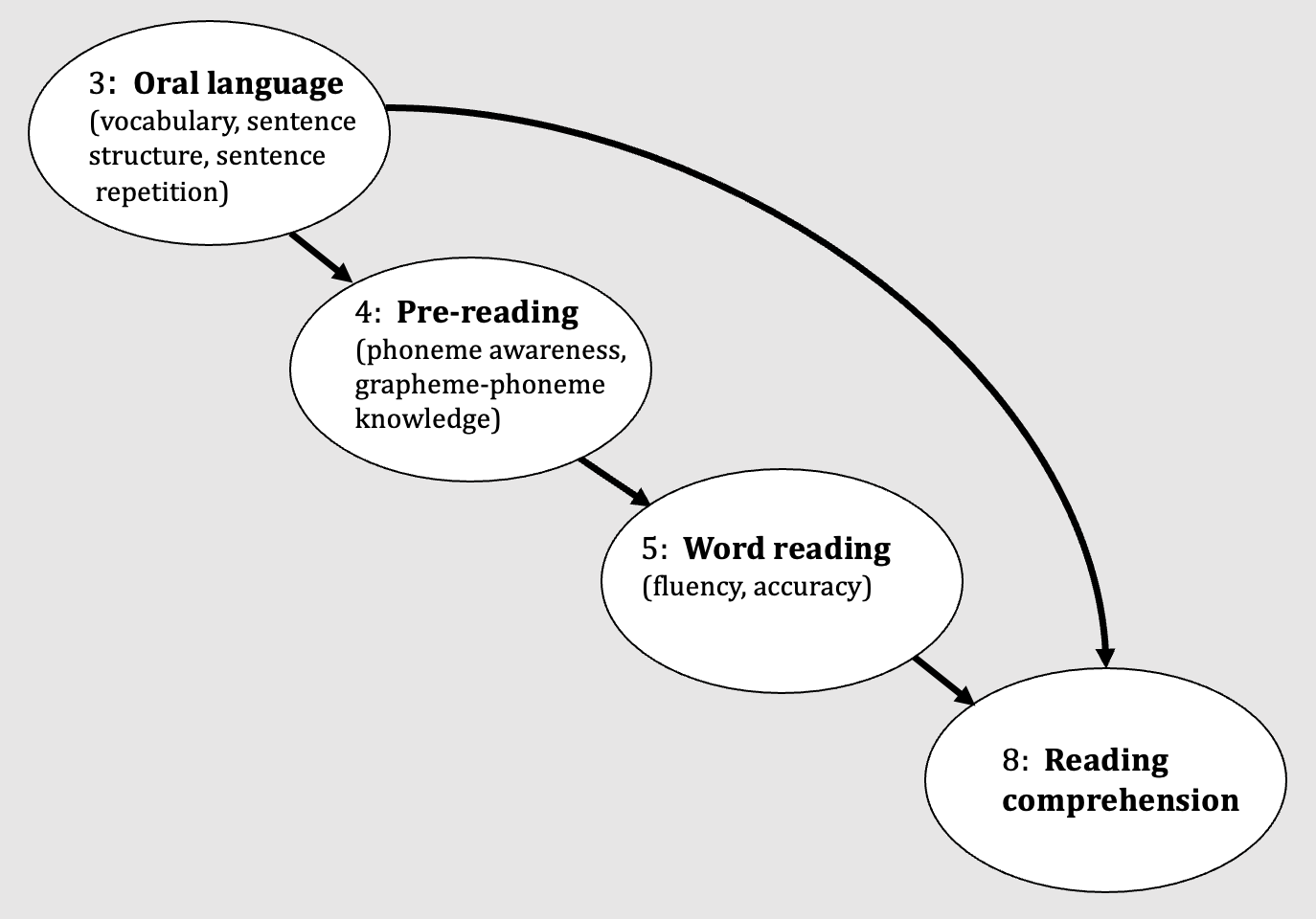
Findings about the relations between language development and reading are of supreme importance for educators. A lot of effort is going in to better ways of teaching about print. There’s been less focus on language development and differences, even though their importance for reading is well-established. My guess is that this is due in part to overreliance on the Simple View of Reading. As Gough and colleagues noted, the beginning reader’s main challenge is learning how print relates to the spoken language they already know. That “already know” should come with obligatory qualifiers, however. Children “already know” language at the level of a 5 or 6 year old, BUT children’s knowledge of spoken language varies in ways that affect reading, including the efficacy of instruction, AND spoken language continues to develop through the lifespan, shaped by exposure to speech and, crucially, texts, which contain language rarely used in speech.
Ameliorating the impact of language differences seems to require both providing greater opportunities for language learning (e.g., in pre-K) and in school. How exactly to do achieve this is the focus on much ongoing research.
