The Simple View, the Simple Point, and Barking at Print
Shortly after my reading book was published, I heard from a teacher who was agitated because her students were very good at reading words, she said, but poor at comprehending texts. At the time I found this utterly puzzling. Words are words because they have meanings (otherwise they are pronounceable nonwords). How could a child “read” a word correctly and not understand it? What she described sounded like hyperlexia, which is an unusual condition observed in some children on the autism spectrum. Although there has been a big increase in diagnoses of individuals as autistic surely there wasn’t a cluster of hyperlexics in one place! I wasn’t much help to her. Recently, teachers at a state Science of Reading convention asked me a similar question: why were students who passed their first and second grade annual reading assessments struggling to comprehend texts in grade 3? The situation is less puzzling to me now, though still disconcerting.
My understanding of this phenomenon goes back to the Simple View of Reading. This year is the 40th anniversary of the first Simple View article by Phil Gough and Bill Tunmer. Everyone in the Science of Reading (SoR) community knows about the Simple View. It is remarkable how much impact it has had. Most of the major tenets of the SoR approach can be traced to it, along with the two other works in the SoR canon, the Reading Rope and the report of the National Reading Panel.
I have fond memories associated with the Simple View. Gough organized an amazing conference that was held at the University of Texas-Austin in 1986 (yes, I’m that old; no, I wasn’t 13 at the time). I gave one of the talks along with a who’s who of reading researchers, people who really set the agenda for the next few decades of research.[1] I remember meeting Gough and Tunmer, who both gave talks. I was young, it was very stimulating, I met a lot of people whose work I greatly admired then and for many years after. Good times.
I liked the Simple View because it made an important point in a succinct way: beginning readers know spoken language (at the level of a 5 or 6 year old), having acquired it the way very young children do, mainly through exposure and use. In learning to read, a person doesn’t re-learn language; they learn how to access knowledge of language in a new way. Becoming a reader thus requires being taught about print and gaining the ability to use it to access the meanings of words known from speech. Good point. I mentioned it in my book.
A couple of decades after it was formulated, the Simple View acquired a second life as a pillar of the SoR approach. As a researcher living in 2026 there is no reason for me to deconstruct the Simple View. It would be sufficient to note its historical importance: it helped to stimulate research that led to deeper understanding of the issues that it raised and to theories that superseded it. As a researcher interested in educational policies and practices, however, I think it is necessary to delve into it for a different reason: because of the ways it has been represented and used in the SoR movement and its continued influence on policies and practices.
Critiquing the Simple View is not fun. Teachers love the Simple View. It makes intuitive sense. It explains why phonics instruction is important, and it affirms the teacher’s role in bringing the child into literacy. It makes a basic point that is both useful and true. The good will it generates, however, has led to overlooking two issues: first, it got some basic things wrong; second, it is being used as the scientific basis for things it didn’t address. Saying that a product or practice is consistent with the Simple View, or based on the Simple View, or aligned with the Simple View, doesn’t buy much, certainly not a guarantee that it is supported by other relevant reading research. As a scientist I rankle at the unscientific ways it has been used in education and at its representation as the crowning achievement in research on reading.
My feeling is that since the SoR relies so heavily on the Simple View, educators should at least be aware of what it did and didn’t say and how those 40 year old claims have fared in light of subsequent research. Teachers might then ask some hard questions about materials and practices that they are being told to use because they are based on the Simple View. We might also hold the publishers, entrepreneurs, and influencers who set policies and sell products based on it to higher standards of evidence. For myself, I feel compelled to try to increase people’s science of reading literacy by presenting and clarifying research findings and calling out their misuse when that occurs.
The Simple Point
The Simple View is, at one level, the observation that at the onset of reading instruction, a child knows spoken language (at the level of a 5 or 6 year old) and needs to learn how to use the spellings of words to access knowledge of them gained from using oral language. Reading thus involves print, language, and the connections between them. This aspect of the Simple View accurately describes conditions at the onset of reading. The beginning reader’s initial challenge is indeed to learn how print represents words that are known from spoken language. This observation is consistent with countless studies because it describes the basic problem of beginning to read. It could be falsified only if we discovered a culture in which children learn to read before they learn to talk, or we found that children ignore what they already know about language in learning about print, or equally fanciful events. I will call this the Simple Point of the Simple View. Every account of reading must include both print and language in some manner given that the minimal definition of reading is “comprehending language in written form.” This point is useful for a teacher or other educator coping with colleagues who maintain that instruction about the associations between print and sound–phonics–is unimportant, an impediment to skilled reading, or only relevant for struggling readers.[2]
Discussions of the Simple View frequently note that it is supported by a hundred or more studies as a way to establish its validity and also convey the depth of reading research. To take two examples, according to the Reading League’s guide to the science of reading, “The Simple View of Reading has been empirically validated by over 150 scientific studies.” According to a Reading Rockets blog, “The Simple View is supported by hundreds of studies which have shown decoding and language comprehension are critical to skilled reading.” What these studies support is the Simple Point.
Gough and his colleagues went beyond the Simple Point, however. Most people know the Simple View through an illustration (below) in which the element on the left is labeled either “decoding” (Gough & Tunmer’s term) or “word recognition.” These terms have multiple meanings in reading research, so to remain neutral I have simply called this print knowledge. This illustration doesn’t appear in the Simple View articles; it was created for use in education and has become an integral part of how the SoR approach is communicated. Whereas the Simple Point is supported by many other studies, the additional claims that this illustration incorporates are not. The SoR nonetheless employs instructional practices based on them.
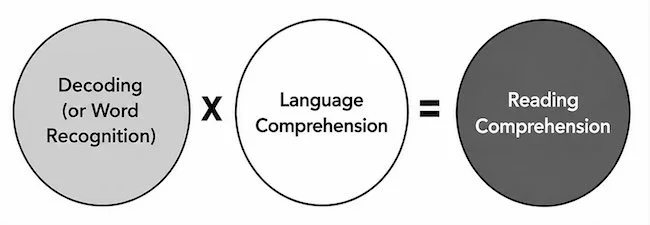
Although every account of reading will include print and language, the Simple View exaggerates the differences between them, ignoring commonalities in how they are learned and how they affect each other in learning to read and in skilled reading. The net effect is to create an artificial boundary between them that has deleterious pedagogical effects. The beginning reader’s great task is to integrate written and spoken language, to the extent that written language is comprehended quickly, accurately, and automatically–like spoken language. Treating print and language as separate components works against this goal.
The illustration accurately reflects Gough and colleagues’ 1980’s era view that print and language are very different: different types of knowledge, acquired in different ways, at different points in development. The print part consists of knowledge of the written code that is used to access knowledge of words gained from speech. The [spoken] language comprehension part includes the meaning-making machinery: word meanings, how they combine to form sentences, their communicative uses. Beginning readers can comprehend and produce spoken language but know little about print. Spoken language is acquired “naturally” because it is a capacity that evolved in the species; because writing is a relatively recent invention, learning to read is an “unnatural act” (as Gough put it elsewhere) that requires explicit instruction. The equation also illustrates that both components are necessary: if either of them is zero, so is reading comprehension.
The SoR has taken these claims about differences between print and language very seriously, and it is easy to see why. The Simple View offers a corrective to the fundamental fallacy in the Whole Language approach, the assertion that learning to read should be like learning to talk, accomplished by engaging in the activity rather than being taught. With this point refuted, the plan for reading instruction is clear: The child doesn’t know much about print and won’t learn it unless taught. The child knows a lot about language, which isn’t learned via instruction. It follows that instruction should focus on the print part: letters and combinations of letters that symbolize the sounds of words and procedures for using this information to decode words.
These claims about the relations between print and language have misled educators in three areas.
1. Language development. The Simple View focuses attention on instruction about print, which was inadequate in Whole Language, but in doing so turns attention away from language development. Treating language as something that is simply acquired “naturally” and in place at the start of reading instruction overlooks several crucial facts (see chapter 6 of my book for details and references). First, children’s language development varies substantially, mainly due to environmental factors, with downstream effects on learning to read. Second, language continues to develop after reading instruction begins. Although first language learning largely occurs without explicit instruction, what children learn depends on characteristics of the language they experience. For children who are below grade or age-level expectations, the need to facilitate further language development is especially acute. School can be a rich language-learning environment if suitable learning experiences are provided. That opportunity can be overlooked on the view that language is acquired “naturally,” whereas print requires extensive instruction.
2. Learning. The idea that reading must be explicitly taught whereas language is learned naturally is among the core tenets of the SoR. It is only partially correct.
The correct part is that at the onset of learning to read, children require explicit instruction to a much greater extent than had been required when they learned their first, spoken language. Nascent readers have to be taught several things to even get started, beginning with the fact that there is something we call reading, and that it involves a visual code that represents spoken words in specific ways. This instruction begins with the very young, via alphabet books, blocks, and other playthings. In contrast, children do not have to be taught that there is something called language that consists of sounds, words, and sentences. Looking beyond this initial difference, however, the ways we learn about print and language are similar. In both cases, most of what we know is acquired without explicit instruction as we engage in activities such as reading and talking.
The brain has two complementary learning systems. Learning via the explicit system is relatively slow, requires conscious awareness, and relies on language. Learning via the implicit system occurs automatically, without conscious awareness or intention, and involves many kinds of information in addition to language. It is sometimes called “statistical” learning because it involves picking up on patterns in the environment based on their frequencies and similarity to one another. This type of learning goes on in the background as we engage in activities such as reading or talking. (3) Learning via this system involves a very large number of small adjustments to the neural networks that underlie such behaviors. Most of the knowledge that supports reading and language is learned this way. (See further discussions here and here; review article here).
My favorite example is vocabulary. First graders typically speak at least several hundred different words and comprehend several thousand. Some words are taught (as when a toddler is taught the names for colors, animals, and objects) but these are a small fraction of the words they know. The rest were learned implicitly through language use. Implicit learning is the engine behind children’s amazing language acquisition capacities.
Knowledge of the written code is also mainly acquired via implicit learning (my book, chapter 7). The spellings of words exhibit complex statistical patterning, as do the mappings between spelling and sound. Readers learn an enormous amount about the frequencies of letters and letter combinations, at different positions in words of different lengths, which sequences of letters form words, and how those patterns relate to spoken language, among many other properties of print. The general developmental pattern is that they learn some of these patterns through explicit instruction, and then use what they have learned to expand their knowledge via a broad range of reading and writing activities that enable implicit learning. Explicit instruction thereby scaffolds implicit learning.
Just as the Simple View draws too much attention away from spoken language, it also focuses too heavily on the need for explicit instruction about the written code. The authors may not have intended this interpretation, but it has been taken to mean that the only way that children can learn about print is if it is explicitly taught; the Whole Language fiasco is seen as demonstrating what happens when it isn’t. The SoR thus incorporates explicit instruction about numerous properties of print, as seen in Carol Tolman’s well-known hourglass illustration. However, the fact that some explicit instruction is initially required in some such areas does not mean that is the only or even the main way they are learned.
Finally, even if it had proved to be true that language and print are learned by wholly different mechanisms, it would not follow that instruction about print shouldn’t capitalize on knowledge of language as much as possible. Allegiance to the Simple View discourages this approach, unfortunately.
3. Relations between print and language in development
Treating print and language as independent components of reading comprehension runs counter to the main theme of my book, that the two are interrelated at every turn. As the book’s title indicated, reading is language in the visual rather than auditory modality. Charles Hulme and Maggie Snowling have recently stated this point in the maximally succinct way: reading is language. Reading and speech are alternative ways to build, maintain, and access shared knowledge about words, grammar, uses of language, and so on. Orthography and phonology are so closely related that what is learned about one depends on and changes the other (my book, pp. 28-29). The close relations between written and spoken language make it hard to draw a clear distinction between them, which is why there is equivocation over what to even call the print part in the Simple View and over what it includes.
My book provided extensive evidence about the interdependence of print and language, including the invention of writing, the puzzle about how alphabets arose, the role of alphabetic knowledge in developing the phonemic illusion, the role of phonological processing impairments in some types of dyslexia, effects of spelling on spoken language processing, the impact of differences in knowledge of spoken language on reading, and others. Here I will mention an additional study, inspired by the Simple View, that directly addressed the influence of print knowledge on language, and vice versa.
Hulme and Snowling and their colleagues have conducted extensive behavioral studies of reading acquisition in several languages. They often use the Simple View to frame their research, but their studies have repeatedly shown that language greatly affects learning about print. At some point one has to conclude that the Simple View’s print-language dichotomy is fundamentally incorrect. In a recent project, they assessed the impact of print and language on each other in a very direct manner.[3] Perhaps this is the final straw.
The study examined reading and language skills in a sample of 230 children who were assessed yearly between ages 5 and 9. The study included multiple measures of children’s performance. In the crucial analysis, the language measure was expressive vocabulary, assessed using a standardized test of picture naming. Providing the names for pictured objects requires knowing the meaning of the words, which in the Simple View is a component of language. Print knowledge was assessed using a word naming task. Correctly reading words aloud requires knowledge of print-sound mappings but not necessarily their meanings. Reading comprehension was assessed using another age-appropriate standardized measure. The design of the study allowed the researchers to examine the impact of each of these factors on each other and on reading comprehension at multiple points in time. As expected, both print knowledge (spelling-sound mappings) and language (vocabulary) affected reading comprehension. More interesting, the analyses show that language measured at one point in development (t1) affected word reading at a second point (t2). Word reading at t2 then affected language at a third point in time (t3). Thus they observed the impact of print on language and of language on print in a single study of the same children.
These results are compelling, though in my view it would have been surprising if the study had come out differently. The results are correlational and so one has to look to theories of word recognition to understand the causal mechanisms. Why, for example, is reading words aloud associated with vocabulary growth? Reading words aloud can be an opportunity to gain or strengthen knowledge of their meanings, if the activity is structured appropriately. A reader can tell if a word has been pronounced correctly by treating the sound as if it had been spoken to them (as in Share’s Self-Teaching mechanism). This will result in the activation of the word’s meaning if the pronunciation was correct and the word is known from speech. This mental activity results in strengthening the neural pathways connecting spelling, sound, and meaning. If the word is not known from speech, that can be a signal to seek information about it. In short, the meanings of words can be incorporated in instruction about learning to read them, benefiting both vocabulary and phonics.
The Simple View, in contrast, treats learning spelling-sound correspondences as a code-breaking activity distinct from vocabulary, which is in the language bin. In line with this account, it is possible to teach phonics without reference to the meanings of words. Children can be taught the pronunciations of meaningless parts of words such as vowels, consonants, complex onsets, and rimes, as in popular phonics curricula. They can also be taught how to pronounce words containing such patterns, focusing on accuracy and fluency rather than their meanings. The National Reading Panel’s treatment of fluency as a teachable component of reading also encourages this practice.
Separating the mechanics of decoding words from their meanings is a risky practice. It is how a child could become very good at generating pronunciations of words from print without understanding what they’ve said. We do not as yet have much relevant data about classroom practices in the SoR, and instruction will rarely be all or none. However, there is reason to be concerned. It’s reflected in the questions those teachers asked me about their students who could decode words but comprehended poorly. Perhaps the answer is that code instruction that focuses on reading words aloud accurately and fluently can lead to barking at print.
“Barking at print” is an old-school expression for reading aloud without adequate comprehension. It reflects the classic concern about phonics instruction, that it could teach children to read words without understanding them. The term resurfaced in a 2007 article by researcher S. Jay Samuels that criticized the use of the DIBELS instrument to assess reading proficiency. The K-2 assessments included measures such as fluency in naming letters and identifying phonemes rather than ones that assess word and sentence comprehension. Samuels asked whether proficiency on such tasks was a good index of progress in reading or merely encouraged barking at print.
It is possible to become skillful at such tasks without understanding much of what is read. This dubious feat is easier to accomplish in a shallow orthography such as Hebrew (my book, p. 136), but educational practices could permit it to happen in English: Teach simple spelling-sound correspondences and then words that incorporate them; create “decodable” texts that mainly consist of such words; practice reading the words and sentences multiple times; assess accuracy and speed more than comprehension: Sounds like a recipe for barking at print.
Given the Simple View’s strong distinction between print and language and the way it has been embraced in the SoR, Samuels’ concern is again highly relevant. Later versions of the DIBELS assessment (and commercial products based on it) continue to be widely used to assess student progress. Pressure to produce good results on these assessments can encourage teaching children to perform the tasks they include, such as nonword reading, which is the sine qua non of barking at print. Such a mistake! There is no evidence that nonwords are a more effective vehicle for teaching spelling-sound correspondences than words. Leaving meaning out of phonics wastes an opportunity to build and strengthen vocabulary knowledge, an important consideration given the language differences that exist at the onset of reading instruction and the limited amount of time available for instruction.
The concern, then, is that the Simple View, as interpreted in the SoR, validates a shallow level of engagement with print, focused on the mechanics of decoding rather than reading for meaning. Doing this to excess could limit the time available for activities that involve actual reading (that is, comprehending texts). Cognitive psychologists long ago recognized that activities such as reading words can be undertaken at different levels, a concept called “depth of processing.” In reading the word TRAIN I can ask you if it contains a particular sound, if it rhymes with “plane,” if it is a noun or adjective, or if it refers to a type of vehicle. These tasks range from shallow (superficial properties of words) to deep (semantics). Separating print (decoding) from language seems to enable relatively shallow processing compared to what is required for comprehension. Of course, instruction about print isn’t the only thing that happens in teaching children to read; often there is a main comprehensive curriculum as well as a supplemental one that focuses on phonics and sometimes other basic skills. I can’t judge how much time is being spent on different activities or whether there are sufficient opportunities to put the instructional pieces together. There seems sufficient reason to raise the concern.
Researchers continue to study the many ways that knowledge of language affects learning about print, but the fact of this influence is well-established. It is also important to recognize the complementary impact of learning about print on knowledge of language, as seen in the Hulme et al. study. The two effects are sometimes described as “reciprocal,” but the relation between them changes with development.
Children’s knowledge of language is initially tied to their exposure to and use of speech. In learning to read, the child gains access to this knowledge from print. For those who become readers, however, texts take over as the main source of additional linguistic knowledge. Texts contain words, phrases, and grammatical constructions that are rarely used in speech. Reading changes what is in the language component, a further blow to the Simple View’s sharp distinction between print and language.
To summarize, I’ve identified two serious concerns about the use of the Simple View in the SoR. One is that the SoR employs instructional practices based on parts of the Simple View that haven’t held up in light of later research. I’ve asked whether this is leading to an excessive focus on the mechanics of decoding at the expense of comprehension. The other is the way the evidence for the Simple Point (which is voluminous) is used to justify other claims about reading said to be based on the Simple View. Empirical evidence isn’t transferable. The fact that one part of the Simple View is supported by many studies doesn’t bear on other beliefs, claims, and proposals inspired by it. A product or practice isn’t grandfathered in by evidence for the Simple Point, but that is how those “hundreds of studies” have been used in the SoR.
That is enough to say about the Simple View. Whatever its service in helping to get the SoR approach off the ground, it is also important to recognize its flaws and the extent to which it inspired questionable practices. Continuing to treat it as “the big idea in reading research” is a barrier to making better use of what is actually known about reading, language, learning, and development.
Footnotes
1. Other participants included Treiman, Ehri, Goswami, Perfetti, A. Liberman, Stanovich, and Don Shankweiler, who died recently. Don was the last of the original core of researchers at Haskins Labs who studied connections between reading and language for many years. Don was an exemplary scientist (one of the creators of the “alphabetic principle”) and a kind person who was always very generous to me.
2. Gough and Tunmer were actually uncertain about phonics instruction. At the time, researchers were debating whether word recognition is “direct” (spelling to meaning) or “phonologically-mediated” (spelling to phonology to meaning). Gough and Tunmer considered these arguments inconclusive but also not immediately relevant. Their claim was about the need to connect print to existing knowledge of language, not about exactly how this should be taught or how it is achieved in skilled reading. A later theory by Harm and myself described the division of labor between visual and phonological processes in reading and how it changed with increasing skill. According to this theory, which has held up pretty well, the orth-phon-semantics pathway gets off the ground more rapidly; the orth-semantic pathway develops more slowly but eventually plays an important role. Phonics instruction that employs meaningful vocabulary can enable children to develop both pathways in parallel.
3. Implicit learning probably also occurs during explicit instruction, although I do not know of any empirical studies of this. Explicit instruction about, say, the pronunciation of the digraph AI may be important, at least in part, because the pairing of the spelling and sound that occurs also affords statistical learning of the association.
4. Presented at the 2026 meeting of the SSSR.org.
