The Great One, Wayne Gretkzy: What Misspelled Jerseys Say About Learning to Read
A friend has sent me a post about misspelled names on the uniforms of professional athletes. It’s an old post but new to me. Such errors are amusing because they seem so colossal (shouldn’t someone have caught that??) but also familiar (who among us has not made similar ones?). They are also of interest because they illustrate some basic facts about reading and spelling that are relevant to education.
I did a little looking around and found the following attested errors.
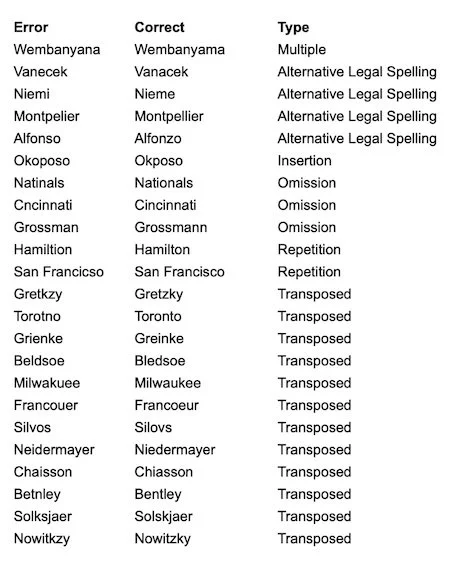
Although I’ve informally categorized the errors, some of them have multiple explanations. For example, the misspelling Wembanyana could occur because the m and n are close in both pronunciation and sound (and the letters are similar, too), or because the “yan” syllable is higher in frequency in English and easier to pronounce than “yam” (though probably not in the Bantu language of origin). Some errors clearly arise because of ambiguity in sound to spelling mappings in English. Alfonso and Alonzo are similar to homophones such as cell and sell and so one would have to know how the player spells it in order to, well, spell it correctly. But, the error could also be related to the fact that the two phonemes only differ by one phonetic feature, which makes them easily confuseable.
The most common type of error involves transposing letters, and it is the most interesting.
Transposed Letter Effects
Errors such as Beldsoe for Bledsoe involve swapping the positions of two letters. In the early 2000s there was a flurry of research on how people read words with transposed letters. Participants performed a lexical decision task: they were presented with a string of letters and had to decide if it was a word or a nonword by pressing a button. In the simplest case there were three types of stimuli:
Words: SILVER
Transposed-letter nonwords: SIVLER
Control nonwords: SIDLER
The participant sees many items of each type in random order. Typically each item is presented for a brief duration (150 or 200 msec) and then covered by a masking pattern, which makes the task harder. The critical comparison is between the two nonword conditions. Sivler and sidler are both nonwords, but only sivler is derived from a word. The key finding is that people make more errors on nonwords such as sivler (their response latencies are usually longer as well). Knowledge of the word silver interferes with deciding that sivler is not a word.
Such results indicate that words are not processed letter by letter from left to right. If they were, sivler and sidler would be equally easy to reject. In modern theories of word recognition, letter strings are processed in parallel (subject to limits on the perceptual span: see my book, chapter 4, or ask a chatbot to explain). The difficulty of recognizing a word (or deciding that a letter string is not a word) depends on how much it overlaps with other words. Sivler is both very close to silver and not close to any other words. That makes it harder to decide that sivler is not a word. Sidler doesn’t entail the same complications.
The same thing happens with misspelled jerseys. Beldsoe is both very close to the name Bledsoe and not very close to any other names. That makes it easy to overlook the misspelling–at least for a while.
Implications for Reading Instruction
What does this mean for how reading is taught?
Whereas skilled readers process letter strings in parallel, early instruction emphasizes sounding out words letter by letter. This procedure—often called “decoding”—is essential for beginners, giving them a way to translate print to sound. This procedure is efficient insofar as knowledge that is used in reading one word is also used in reading many others. It is the alternative to treating every word as a distinct pattern to be memorized: “sight word” reading. The problem of course is that the pronunciation of a letter–especially a vowel–often depends on letters that come later, as in these examples:
sat, sad, sag sate, satiate, satisfy
sand, sank, salt sarah, sarge
And then there are oddballs such as says.
Beginning readers “decode” words left to right and skilled readers “decode” words in parallel. The goal is for the child to transition from one to the other. The questions, then, are: How much explicit instruction and practice in decoding words from left to right is needed to make the transition to the skilled procedure? How exactly does this transition happen? And how can instruction facilitate it?*
I’ll address those question in my next post, I promise. Here I simply want to make it crystal clear that skilled reading is not equivalent to being really good at processing words left to right, letter by letter. That is the training wheels procedure. The goal isn’t for children to become highly skillful at using it. Rather, it is for them to become good enough at using it to launch the parallel process. Extended instruction in left to right decoding cannot be justified by saying it’s teaching children what skilled readers do.
I’m not sure how widely accepted this point is in the “science of reading” approach. There is certainly heavy emphasis on using the letter-by-letter procedure, which involves teaching many phonics rules as well as strategies for how to correct errors, plus extended practice in using them. The left to right procedure also requires blending the phonemes that have been generated into a word, which can involve additional instruction and practice. How much of this would be necessary if it were more widely recognized that reading words this way is only an interim step along the path to skilled reading?
A Final Thought
Misspelled jerseys may seem trivial, but they offer a window into a fundamental property of the reading system. The fact that Gretkzy can pass for Gretzky tells us that reading is not a letter-by-letter process. It’s heavily influenced by top-down knowledge of words. This isn’t “guessing,” in the 3-cueing sense. It’s what skilled readers do, automatically, without effort or intention, using their knowledge of the lexicon–which sometimes produces amusing errors.
For educators, the takeaway is that teaching children to read needs to start with decoding words left to right, but with the goal of transitioning to reading words in bigger chunks. That is something that instruction can facilitate.
Mroe sono.
—---
* I used the term “decoding” here to show that it has multiple meanings that differ in important ways. The core meaning is, the process by which words are recognized. Both the left to right procedure used by beginning readers and the automatic parallel processing used in skilled reading are ways to decode words. I urge educators to keep this ambiguity in mind when using the term. The goal is teaching children to decode words, but the mechanism that is involved changes developmentally.
